
When I Move, a Buffalo Moves
Werner Herzog's writing

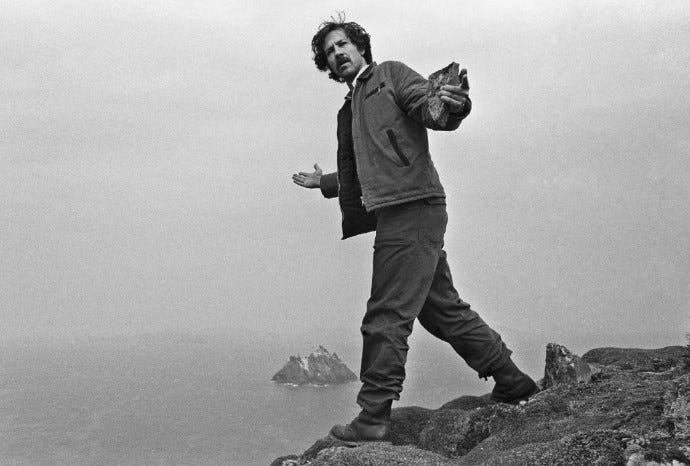
Towards the beginning of Conquest of the Useless, Werner Herzog’s book collecting the diaries he kept while making the film Fitzcarraldo, he’s holed up in Francis Ford Coppola’s house in San Francisco working on the script. “On the wall,” he writes, “I have used a sharp pencil and a ruler to draw a mathematically precise reticle. That is all I see: a set of crosshairs.”
Pure Herzog: the steely resolve, the almost comic intensity. But then, pretty much every statement of Herzog’s is pure Herzog. What is it that he tells that curator from the Whitney when she calls to ask him to contribute something to the next Biennial?
“I said that I didn’t think of myself as an artist and that this term was better applied to pop singers and circus performers. If I wasn’t an artist, then what was I? I said I was a soldier and hung up.”
And what did he say to that astonished BBC journalist after some miscreant shot him with an air rifle as he was being interviewed?
“It’s not a significant bullet.”
He never lets you down. I know that I (along with so many other males) find it impossible to read lines like these without, like a tic, mentally intoning them in that particular accent of his, simultaneously impassioned and robotic. He’s famous as a director, of course, but I think I really prefer his writing. In his movies, he often gets in the way of himself, and his personality upstages the story and the subject. But in his books, he’s the subject, and you sort of get the full whammy – his eloquence, his eccentricity, his domineering will – without any distraction.
For this reason, I was looking forward to his newest book, The Future of Truth, which came out last fall. Unfortunately, it’s a disappointment. Herzog doesn’t bring anything like a sniper’s focus to this one. Reading it feels more like accompanying him as he strolls the countryside with a shotgun over the crook of his arm, occasionally blazing away at a bird or rabbit but mostly just enjoying his Sunday and not too troubled about whether or not he brings back much game. It’s entertaining but pretty slight. It did, however, send me back to a few of his books I either hadn’t read or hadn’t read for a long time, a couple of which are superb, and, I think, underappreciated.
The Future of Truth is a collection of loosely connected essays on subjects including documentary film, AI, and fake news. Herzog discusses Japanese rent-a-families; expresses bemusement at various internet phenomena, including the fake conversations between him and Slavoj Zizek that made the rounds a few years ago; gives a rather Wikipedia-ish history of fake news; and relates the entire plot, in detail, of the 1862 Verdi opera, La Forza del Destino. It’s all a little rambling and unfocused. The Verdi chapter, which could have been a single sentence (”the plot is ridiculous”) makes you wonder how seriously to take the book. It’s hard to tell if Herzog is trying an experiment that didn’t work out or just pulling our leg.
One of the things that attracted me to the book, and what must have interested the publisher, is that its subject seems so timely in the age of screens. A book called The Future of Truth would seem to speak to the widely shared sense that irreality is invading our lives, that simulations are substituting for experience, and that people believe nonsense. The insults to truth in the form of fake news, misinformation, and AI slop are much discussed these days, but rarely very insightfully, and a few of the great director’s stone-faced pronouncements, cutting through the chatter and silencing the room, would be most welcome. But when it comes to these problems, Herzog’s ideas turn out to be pretty much the same as everyone else’s.
A lot is also to do with education. Teachers are not sufficiently praised or rewarded in our society, even though teaching is one of the noblest and most important of callings.
Read more. A three- or four-sentence tweet can’t possibly do justice to a complicated reality.
Where the internet is concerned... assume guilt, be suspicious, expect manipulation, propaganda, lies.
Not significant bullets. It really shouldn’t be too surprising that Herzog’s foray into theory isn’t inspired. He’s said many times in writing and interviews that he hates theorizing, philosophizing, and psychologizing, all useful things to be interested in when you’re writing essays on the concept of truth. When Herzog writes about politics or AI, he comes perilously close to banality. But when he just writes about himself, he’s electrifying. Later in Conquest of the Useless, far from Coppola’s house, he describes this scene deep in the Peruvian jungle:
Profoundly unreconciled to nature, I had an encounter with the big boa constrictor, which poked its head through the chicken wire surrounding its wooden cage and looked me fearlessly in the eye for a long time. Stubbornly confronting each other, we were pondering the relatedness of the species. Both of us, since the relatedness was slight, felt sad and turned away from each other.
Herzog is no herpetologist, and neither he nor the reader has any idea what the snake was actually feeling during this encounter, but his fantasy interpretation of it rings true somehow. It’s a version of the scene we get again and again throughout the book: the director surrounded on all sides by the “obscene, sinful” jungle and staring back at it, entranced. An earlier book of diaries, Of Walking in Ice, chronicling the three weeks he spent walking from Munich to Paris in 1974, is just as good. Like Conquest, it’s an infernal travelogue in which the gloomy landscapes Herzog documents are not distinguishable from his own stormy internal landscape. In this case his goal isn’t to make a film but to save a life by an act of pilgrimage: he set off on his trip when he learned that his friend and mentor, the writer Lotte Eisner, was in the hospital and might die.
Our Eisner mustn’t die, she will not die, I won’t permit it. She is not dying now because she isn’t dying. Not now, no, she is not allowed to. My steps are firm. And now the earth trembles. When I move, a buffalo moves. When I rest, a mountain reposes.
The diary form suits Herzog perfectly because he’s at once a keen observer and totally self-absorbed, with no interest in objectivity. Why did he write a book about truth? He’s an artist. Of course truth, for him, is going to mean illumination, epiphany – a feeling. Even more than other artists, the defining characteristic of his work is its overwhelming subjectivity. Herzog’s art is impossible to separate from his personality. As Michael O’Connell wrote in a perceptive essay in the NYRB on the occasion of the publication of Herzog’s memoir, “his real masterpiece is the character known as Werner Herzog.” Dwight Garner, in a rather sour review of the same book, wrote that Herzog has “an ego the size of Buenos Aires.”
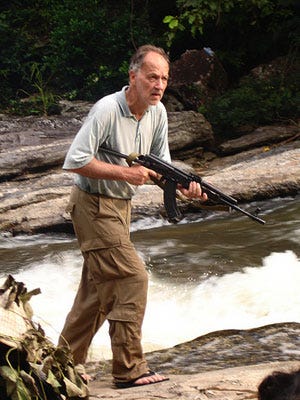
Both critics are right. In The Future of Truth, Herzog defends, not for the first time, his idea of “ecstatic truth,” which he opposes to the factual truth of journalistic convention, which he calls “the truth of accountants.” But it’s doubtful his audience cares about this debate anymore. We understand that Herzog’s documentaries are something like ecstatic journalism. What the viewer might object to about these films is not that they take liberties with the truth but that the director doesn’t seem to have much feeling for characters unlike – or other than – himself. His best documentaries are the ones about subjects strong enough to stand up to him: 40,000 year old cave art, the internet, Antarctica, Klaus Kinski. He’s also very good with murderers, in his series Into the Abyss. At other times, Herzog’s subjects either get thrown into the shade by the director or remain opaque because he’s incurious about their psychology (as he professes to be incurious about his own).
This is true of his 2022 novel, The Twilight World, about the life of Hiroo Onoda, a Japanese soldier who spent 28 years in the Phillipine jungle, refusing to believe the war was over and doggedly continuing his military mission. The book really isn’t bad. It has a haunting, solitary atmosphere, but because Herzog never attempts to get inside the mind of its central character, it lacks power. By far the best part of the book is the introduction, in which Herzog tells the story of how he came to meet the novel’s real-life hero. This came about, he says, only after he had first been invited to meet the Emperor.
I replied: ‘My goodness, I have no idea what I would talk about with the Emperor; it would be nothing but banalities.’ I could feel my wife Lena’s nails digging into my palm, but it was too late. I had declined.
It was a faux pas, so awful, so catastrophic that I wish to this day that the earth had swallowed me up. Around the table, everyone present froze. No one breathed. All eyes were fixed on their plates, no one looked at me, a protracted silence made the room shudder. It felt to me as though the whole of Japan had stopped breathing.
When Herzog treads the road in Bavaria, he keeps death at bay in Paris; when he makes a faux pas in Tokyo, all Japan holds its breath. You can hardly expect someone whose career has been spent dissolving the distinction between the world and his own ego to suddenly stand back and offer cool and insightful commentary on contemporary culture. Why he tried, I’m not sure, but he doesn’t need to. His entire career is a rebuke to the disembodied culture of online life, and his contribution to the debates about AI, misinformation, the post-truth era and all the rest of it is not to offer punditry but to provide a kind of heroic counterexample. Can there be anything less online than walking from Munich to Paris in late November, breaking into houses at night to sleep? Not to mention any of the dozens of other hair-raising adventures he recounts in his other books. Reading them, one is overwhelmed by the sheer amount of physical reality one encounters: exhaustion, exotic diseases, avalanches and motorcycle accidents, crows and pythons and crocodiles. As a pundit, Herzog sees the future no more clearly than the rest of us. As an artist, though, he just might. In the final chapter of his autobiography, contemplating the replacement of literature and cinema by Tiktoks and tweets, he writes, “The end is coming. I picture a radical turning away from thought, argument, and image.” He continues,
I imagine two mirrors set up in exact opposition reflecting nothing but each other into infinity. But with nothing for them to mirror... No truth, no lie. No river called the river of lies, Yuyapichis, the deceiving river that pretends to be the much larger Pichis River. No Japanese marriage agency ordering a bucketful of sand to be emptied out of a satellite so the bride can be astonished by a shower of meteorites. No more twins living in separate bodies but thinking and speaking in unison.
And he goes on, offering no opinion on this apocalypse but simply narrating it as a kind of natural disaster, along the lines of the death of a star. It’s not hard to see this passage as Herzog contemplating his own mortality and frankly describing it as the end of all meaning on earth. Of this vision, like so many of his others, Herzog could say, quoting Carl Jung (another colossal personality), “Whether or not the stories are ‘true’ is not the problem. The only question is whether what I tell is my fable, my truth.”
When Herzog was one of the cool new directors, I watched The Mystery of Kaspar Hauser or Every Man for Himself and God Against All and found it riveting but not quite what I was hoping for. Much later, I saw Grizzly Man, also a mesmerizing movie, with Herzog drawing the energy to himself in that central scene with no people, just a phone call where he instructs the person he is talking to not to listen to the tape of Timothy Treadwell's awful end.
Then, maybe five years ago, I turned on the radio and heard an interview with a fascinating, vehement yet rather jolly person with a German accent who turned out to be... yup, the Buffalo himself. During the conversation, he said that he thought of himself as a writer first and a filmmaker only by the way. Because he was so unexpectedly engaging, I thought I would read something by him.
That got forgotten, but now I will be sure to. Not The Future of Truth (though you've gotta give it to him for writing a book on current topics at 83 years, even if his critiques are bland), but one of the earlier ones that Labaree mentions.
As for this essay, it was a pure pleasure to read, kept me on the edge of my seat wondering where Labaree would go next while savoring the beautifully crafted prose, each perfectly chosen word, and the inevitable next (often deadpan) joke. Except for the egomania, Herzog has found his match.
I suffer from the same tic as you do and wanted to read aloud passages of this piece in Herzog's voice. Also: the line "His best documentaries are the ones about subjects strong enough to stand up to him" is a perfect image. Thank you!